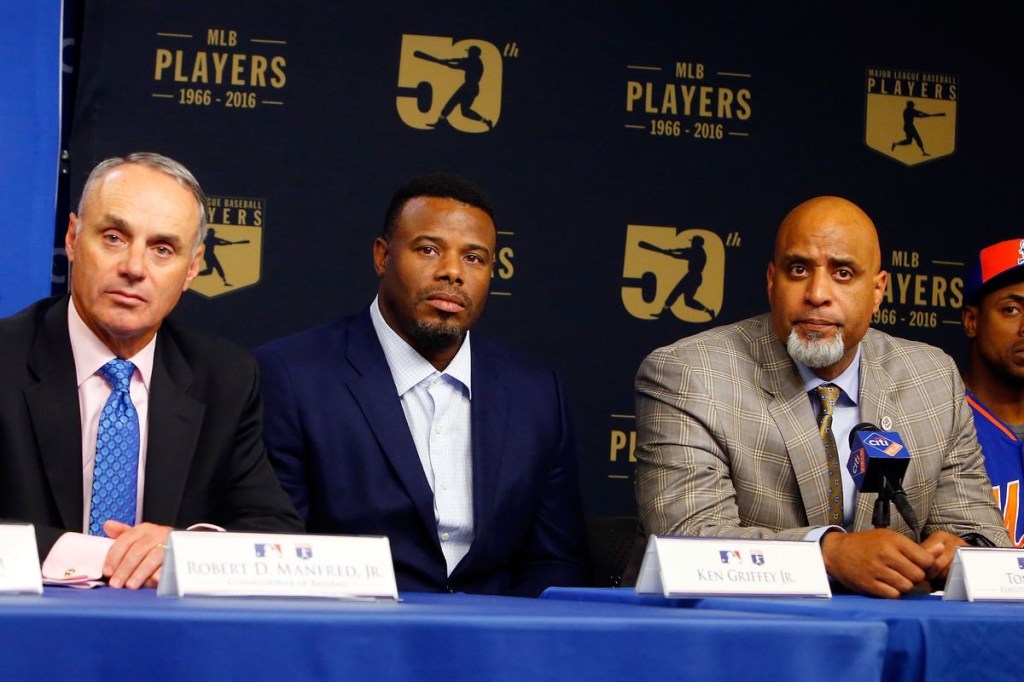
Previously in 2021, MLB owners voted unanimously to enact a lockout upon the expiration of the 2016 collective bargaining agreement (CBA) between the league and the MLBPA. That lockout lasted 3 months, 1 week, and 1 day. This forced spring training to be delayed and shortened and also forced Opening Day to be postponed a week later. The new CBA being signed saved the 162-game season, as all games were able to be made up during the season.
This lockout was the first lockout since the 1994-1995 MLB strike, which was the eighth and longest stoppage in history. The strike began on August 12th and didn’t end until April 2nd, 1995, 232 days later. This resulted in the rest of the 1994 regular season being cancelled, and the postseason. Which was the first time in over ninety years that a World Series was not played.
Now fast forward to today, the Dodgers are continuing to spend money, and fans are in an uproar. Fans on Twitter/X are begging for a salary cap/salary floor for the MLB. Today we will break down what the chances are that a lockout happens in 2026 when this current CBA is over. Also the big things in there that may need changing for the upcoming CBA.
Breaking down the CBA
With over 400 pages in the CBA, there’s lots of stuff that is very obvious that is in there, like the length of the season, the location of where arbitration hearings take place, and more. But we took the most notable things in this CBA that may cause this to be dragged out longer than we all want it to.
– Minimum salaries in the CBA increased by 20k every year, from 2022, ending in 2026.
2022 – 700k
2026 – 780k
-The daily in-season meal and tip allowance when on the road and the team doesn’t provide a meal is $117.50.
-During spring training, players will receive a weekly base allowance of $369.50.
Players who live away from the club’s headquarters receive an additional allowance of $65.60.
The spring training meal and tip allowance shall be $104.50 per day with cost of living adjustments for each year of the agreement.

-Rewards for being selected into the HR Derby/All-Star Game
All players will receive six tickets for family and friends for both the All-Star Game and the HR Derby.
The player and two guests also get first-class plane tickets (if such expenses are actually incurred).
First-class hotel accommodations for the player and two guests.
- Two rooms if necessary
- Max of three days
The applicable in-season meal and tip allowance for 3 days
(set in the 2022-2026 CBA agreement)
$117.50 a day
$352.50 in total
A $1,000 cash stipend
A gift from the players league
Players selected to the All-Star team shall also receive a ring, and if they are attending their 5th, 10th, or 15th All-Star Game, they will also receive a gift/memento and special recognition.
Merch that is made available by MLB’s partners.
- Pre-Arbitration Performance Bonus Program
MLB players with three or fewer years of MLB service are almost always paid the league minimum. Despite how many wins they may contribute to their squad.
The commissioner’s office sets aside a 50m pool to distribute across pre-arb players at the end of each season. Payment amounts are determined by awards won and statistical achievements.
‘Foreign professionals’ are excluded from this bonus program.
Players can also win one of these bonuses per season. The highest amount will always be awarded to the player.
2.5m – MVP or CYA first place
1.75m – MVP or CYA second place
1.5m – MVP or CYA third place
1m – MVP or CYA fourth or fifth place; All-MLB first team
750k – ROY first place
500k – ROY second place; All-MLB second team
The remaining 50m is then distributed to the top 100 players who place in MLB’s metric of Joint WAR.
– Player limits
The current rule allows a team to have a max of 26 players and a minimum of 25 players during the regular season. They are allowed to dip below 25 players due to unforeseen circumstances. They are given 48 hours for players to report.
During playoffs, the roster limit increases to 28. (The old CBA had limits of 40.)
*If active player limits are not agreed upon in this new CBA, then they will revert to the 25 active players during the regular season and 40 during the postseason. (previous 2017-2021 CBA agreement)
-ASG Tiebreaker and ASG Interviews
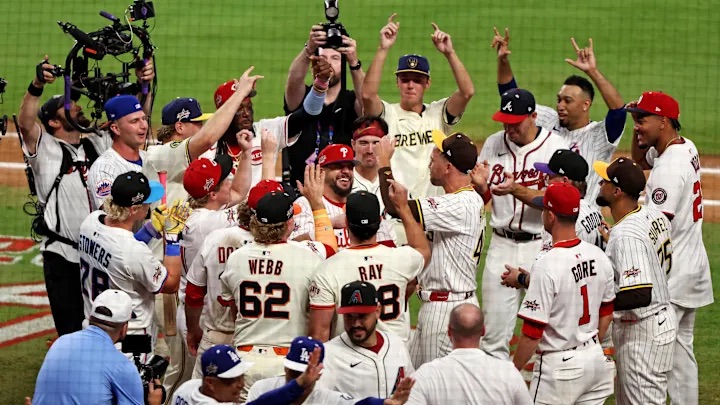
If the ASG is tied after nine innings, each team will pick three players to participate in a HR derby tiebreaker.
Each player gets three swings.
Unlimited number of pitches to hit as many HRs as they can
Team with most HRs wins
If the game is still tied, one player will take three swings until a winner is determined.
The winning all-star team splits an 800k bonus. (previously 640k)
Each player is encouraged to have a catcher, first baseman, and an outfielder wear a microphone during the All-Star Game.
MLBPA guarantees that at least two players will wear microphones during the game.
Players that agree to the interview will receive 15k.
– Special Events
If a player is set to play at a venue other than an MLB or MILB ballpark, they will receive 20k for each game they participate in.
MLB also agrees to donate 100k to the Player’s Trust charity for each special event.
Each team will receive 40k per game to distribute among non-playing personnel who participate in the special event.
- Uniform Opt-Out Dates
If a player notifies their team in writing by 2 pm ET, six days prior to the start of the regular season, requesting his unconditional release.
The club has until noon ET on the fourth day prior to the regular season to add the player to its Opening Day 26-player roster, MLB injured list, or grant his unconditional release.
A player may do the same on April 27th and May 28th.
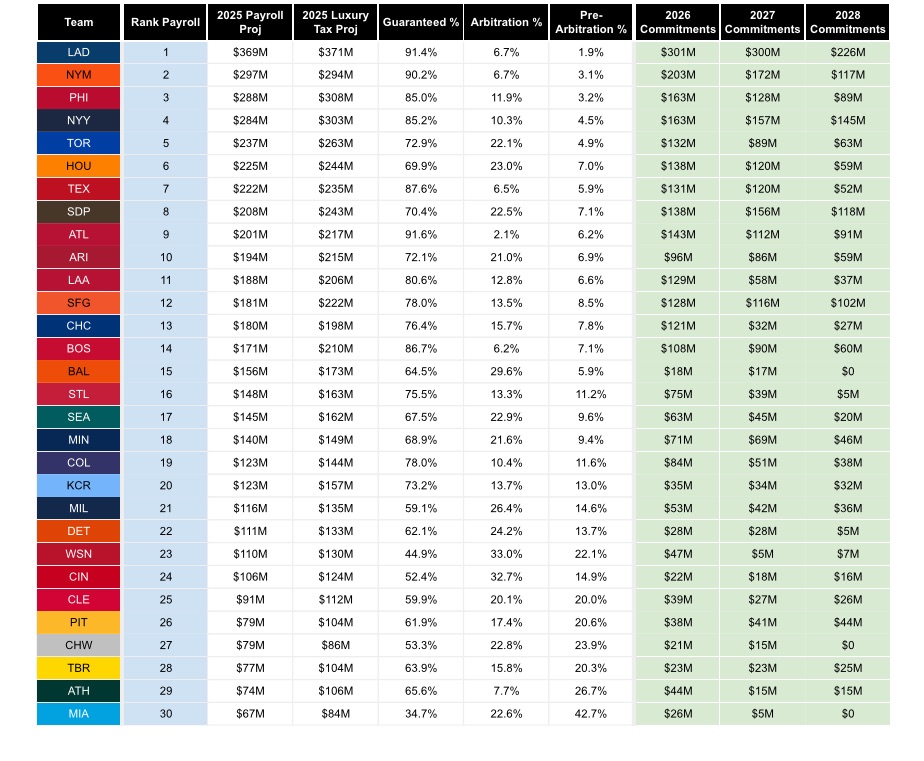
- Luxury Tax Surcharges
1st Threshold
2022: 250m
2023: 253m
2024: 257m
2025: 261m
2026: 264m
2nd Threshold
2022: 270m
2023: 273m
2024: 277m
2025: 281m
2026: 284m
3rd Threshold (Newest threshold added in the CBA)
2022: 290m
2023: 293m
2024: 297m
2025: 301m
2026: 304m
Surcharge Rates and Competitive Balance Tax
• A team exceeding the first threshold pays a 12% surcharge on top of the base tax rate for the amount above the threshold.
• Exceeding the second threshold incurs an additional 45% surcharge on top of the base tax rate for the amount above the threshold. First-time competitive balance taxpayers pay a reduced 42.5% surcharge.
• Exceeding the third threshold results in an additional 60% surcharge on top of the base tax rate for the amount above the threshold.
Draft Penalties
• Teams with payrolls at or above the second surcharge threshold will have their first draft pick moved back 10 places.
• If the team’s first pick is in the top six, the penalty applies to the second-highest pick instead.
Allocation of Luxury Tax Proceeds
1. The first $3.5 million of luxury tax proceeds is used to fund MLB Players Benefit Plan Agreements.
2. The remaining proceeds are split:
• 50% goes to fund contributions to players’ individual retirement accounts.
• 50% funds a commissioner’s discretionary fund.
Commissioner’s Discretionary Fund
• This fund supports payee clubs that demonstrate efforts to grow non-media net local revenue over time.
• Criteria for fund distribution include:
• The club’s non-media revenue growth rate compared to other payee clubs.
• Reduction in proceeds received under revenue sharing through revenue growth.
• Comparison of the club’s non-media net local revenue to its market score and historical averages.
• Paid attendance relative to market size.
• Long- and short-term efforts to increase fan engagement, attendance, and marketing.
- Trading International Bonus Polls
No team is allowed to acquire more than 60% of its original signing bonus pool.
Any signing bonus pool allotments must be made in increments of 250k, unless the team is trading its remaining bonus pool.
Chances of an MLB Lockout?
I don’t want to say 100%, but it’s very high. Essentially the Dodgers are starting to run away and make a super team with the players and payroll. Now I know that any team can absolutely do this; they just simply choose not to. But at what point do we put some rules in place to where this doesn’t get excessive? I am all for dynasties and super teams, but when the fans are begging for changes,. It might be time for the owners to take a stand.
Things like the MLB luxury tax threshold, league minimums, and even the in-season meal and tip allowance will all play a factor in this contract. Now will we see a lockout last as long as the one in 1994? Well, that’s up to the owners, and MLB. But at this point, where the league stands, we are destined for a lockout.
Now, the question emerges: Will the other owners want a salary cap? Like I said, every team can do what the Dodgers are doing. They’ve been building this since the 2010s. But that would mean other teams wouldn’t be able to sign big-name players like they used to, due to a cap space.
Baseball has always been the one sport in the US that really doesn’t have a cap space. While that provides for some interesting headlines like Soto 15yr/765m, it also hurts smaller teams that don’t really bring in as much revenue as the Yankees or the Dodgers.
Personally, I think a lockout is needed in MLB. It gives the opportunity for the owners of mid-market to smaller-market teams to be heard and helped in this new CBA. The league minimum will 100% need to be raised due to inflation and the rewards for being selected as an All Star/HR Derby competitor.
All I’m going to say is enjoy the next two years of baseball, because by the middle of the 2026 season, that will be all the talk across the league. With the current state of the MLB, TV deals, and revenue. It will be all about money this CBA. Strap in, everyone; this has the potential to be bigger than any of us can imagine.

 Bear Sports News
Leave a comment