
ARIZONA – The NCAA is preparing the start finalizing payments for those affected by the 2.6bn settlement. This comes after the NCAA was sued for violating anti-trust laws. The case begun back when the NCAA wasn’t allowing college students to monetize their name, likeness or image (NIL) or allowing them to earn compensation beyond their scholarship. This ended up forcing the NCAA to allow student-athletes to start making money on their name, likeness or image.
These settlements are set to compensate student-athletes for lost opportunities, recognizing their contribution to the team and ensuring fair treatment for anyone in the future.
All current and former (after 2016) Division I athletes, current pros, individual athletes and anyone on the team roster are eligible for the NCAA’s 2.6bn settlement.
The 2.6bn settlement, as originally reported by the Associated Press, is unfortunately forcing universities to make tough decisions, either dropping programs all together, or adding more profitable ones. It’s a issue that Patrick Rishe, executive director of the sports business program at Washington State says that mid-major to smaller Division I schools will need to ask themselves if it makes sense to keep certain programs going.
The Associated Press mentioned that UTEP, Grand Canyon University and Cal Poly have all made decisions to cancel their respective sports programs.
While back in 2020 during the pandemic, multiple universities we’re forced to shut down their programs due to revenue loss. Including U-Conn who was forced to shut down men’s cross country, women’s rowing, men’s swimming & diving and men’s tennis in a move that affected 124 student-athletes.
“This decision was part of a broader university-wide effort to cut costs and allowed the athletics department to meet a directive to reduce institutional support by 25%, approximately $10 million—by 2023.”
Rishe says this time around it’s different. Universities have more expenses to pay rather then revenue being lost outright.
Now while sports programs are always getting cut due to budget reasons, it seems like the 2.7bn settlement is just speeding up the process. While multiple sports programs are getting cut, it’s worth mentioning the schools that are adding programs on during this process.
Marquette has added women’s swimming, and St.Bonaventure and UT Arlington are adding women’s golf to their list of sports programs.
You may be asking yourself at this point in the article, “well why is this important?”
Well as schools start to have their budget meetings, and figure out where money should go, who should get the most, program cuts and other issues. Rishe says that men’s sports are most likely to be cut.
“I would suspect that the sports that are most likely going to be cut are going to be men’s sports, and I don’t say that with malice,” Rishe told the AP. “If you’re trying to stay compliant with Title IX, I don’t know how non-revenue men’s sports aren’t the sports that are more apt to be eliminated.”
What’s Title IX and how it affects sports in the NCAA?
Title IX is a federal law that protects student athletes in the NCAA or in it’s member institutions against sex-based discrimination in educational programs and activities. Title IX mandates equal opportunity to both male and female athletes. Including but not limited to athletic scholarships, facilities, and benefits.
The NCAA and it’s member institutions are expected to comply with said regulations, and are overseen by the U.S. Department of Education’s Office for Civil Rights.
Under Title IX, a education institute or it’s member institutions must provide male and female athletes with equal access to financial aid. Which means if a university puts forward 10m down for scholarships and 45% of it’s athletes are female, then the university will need to put down 4.5m.
In addition, a university must treat female athletes similarly to male athletes and provide them with comparable benefits and access to services. Among other things, these include:
- Athletic equipment and supplies
- Locker rooms
- Facilities for training and competition
- Medical services and facilities
- Coaching and tutoring
- Support services
- Travel allowances
- Scheduling of practices and games
There are three ways a university can comply with Title IX. The main method is by offering athletic participation opportunities to women and men in proportion to their representation in the student body. For instance, if women make up 53 percent of students, then 53 percent of athletic opportunities should go to female athletes.
If that standard isn’t met, a university can still comply by showing it has consistently expanded opportunities for women or by proving it has fully addressed the athletic interests and abilities of female students. A university cannot claim compliance by arguing that women are less interested in sports or that men’s sports bring in more money.
Any school receiving federal funding must have a Title IX Compliance Coordinator. Compliance is assessed by comparing the overall experience of male and female athletes, not by comparing individual teams. A university does not need to offer the same sports for each gender. in which it forms a men’s team, and vice versa.
If a university is found in violation of Title IX, they can be hit with the following punishments.
Loss of Federal Funding
The most serious consequence is the potential loss of all federal financial assistance, including student financial aid, research grants, and other federal support.
Required Corrective Actions
The university may be required to take specific steps to fix the violation, such as adding women’s sports teams, improving facilities, or adjusting scholarship distributions.
Increased Oversight
The Office for Civil Rights (OCR), which enforces Title IX, may monitor the university closely to ensure compliance going forward.
Lawsuits and Legal Liability
Students or athletes may sue the institution in federal court, seeking damages, injunctive relief, or both. Successful lawsuits can result in court orders and financial penalties.
Damage to Reputation
Being found in violation can lead to public scrutiny, loss of trust, and harm to the university’s reputation among students, faculty, and donors.
The non-revenue sports that Rishe mentioned are sports like track and field, swimming, diving, cross country, gymnastics, wrestling, tennis, and volleyball, which are all often categorized as non-revenue sports. Other sports like track and field, swimming, gymnastics, and even soccer can struggle to break even
Non-revenue sports means that it requires a significant amount of investment from the university to cover expenses, including coaching salaries, travel, facilities, and equipment.
Now the NCAA settlement will allow for up to 22% of revenue to be shared with athletes, but it’s obvious that most of the NIL fund, will be used for Football and Basketball as seen from previous numbers in 2024/25.
| Player | School | Sport/Position | NIL Valuation (Estimated) |
|---|---|---|---|
| Arch Manning | Texas | Football – Quarterback | $6.5 million |
| Cooper Flagg | Duke | Basketball – Forward | $4.8 million |
| Carson Beck | Miami | Football – Quarterback | $4.3 million |
| Livvy Dunne | LSU | Gymnastics | $4.1 million |
| Jeremiah Smith | Ohio State | Football – Wide Receiver | $4 million |
| AJ Dybantsa | BYU | Basketball – Forward | $3.8 million |
| DJ Lagway | Florida | Football – Quarterback | $3.8 million |
| LaNorris Sellers | South Carolina | Football – Quarterback | $3.7 million |
| Garrett Nussmeier | LSU | Football – Quarterback | $3.6 million |
| Cade Klubnik | Clemson | Football – Quarterback | $3.3 million |
Now every school will have to handle this process differently, for example Radford University from Virginia recently announced it will drop men’s and women’s tennis but add women’s flag football as a club sport.
As mentioned earlier in the article, Marquette is adding a women’s swim team, which athletic director Mike Broeker said was a decision years in the making and based on demographics.
“I think it’s independent of what’s happening in college athletics right now and more about strengthening our position,” he said. “More females are going to college than males, and that creates differentiation. We want to make sure we’re offering an athletics program portfolio that meets our students’ interests based on our student population.”
Now Broeker’s quote has some more truth to it then just Marquette’s demographics. Recently this year, The NCAA Division I has approved the creation of two financial funds. The Women’s Basketball Equal Conference Fund and The Women’s Basketball Performance Fund. This was created in order to reward teams participating in and advancing through the Division I Women’s Basketball Championship. This decision, made at the 2025 NCAA Convention in Nashville, ‘marked a significant step toward gender equity in college sports’ the NCAA said in a memo released to the public.
Starting with the 2025 tournament, teams will earn “units” based on their performance, similar to the men’s tournament. These units will be distributed to conferences, which can allocate the funds as they see fit, such as rewarding schools for strong schedules and postseason success. The funds will begin at a combined value of $15 million in the 2025-26 fiscal year, increasing to $20 million for 2026-27, and reaching $25 million by 2027-28. After reaching the fully funded amount, the funds will grow annually at approximately 2.9%, in line with other Division I funds .
This initiative is seen as a significant investment in women’s basketball, aiming to continue its growth trajectory and enhance the experiences of female athletes.
Now while the money in men’s sport doesn’t quite add up to the women’s value, it’s no arguing that women’s sports is on the rise. Since Caitlin Clark entered the WNBA, the league has seen significant increases in attendance, viewership, and revenue. Attendance rose 48% from the previous season, reaching an all-time record of 54 million unique viewers across six TV networks. Merchandise sales increased 601%, and WNBA League Pass subscriptions jumped 366%.
In 2023, the NCAA women’s basketball national championship game between Iowa’s Caitlin Clark and LSU’s Angel Reese drew an average of 9.9 million viewers on ABC and ESPN2. This game shattered the previous viewership record of 8.1 million for a 1992 national semifinal. The 2023 championship game also set a record for the most-watched women’s college basketball game ever.
It also just wasn’t the Caitiln Clark and Angel Reese effect that night, the women’s championship game between UConn and South Carolina averaged 8.6 million viewers and peaked at 9.9 million.
There’s no arguing that Women’s Basketball has made a splash and it’s here to stay, with big names continuing to make the rise from college into the WNBA.
Now the NCAA in 2022, reported a 13.5bn revenue, which a major portion of that being brought in from the TV rights deal. It brought in over 4.2bn dollars in revenue, mainly from the March Madness tournaments. Around 60% of the NCAA’s revenue is distributed back into Division I schools.
NCAA 2022 Revenue from Athletic Programs
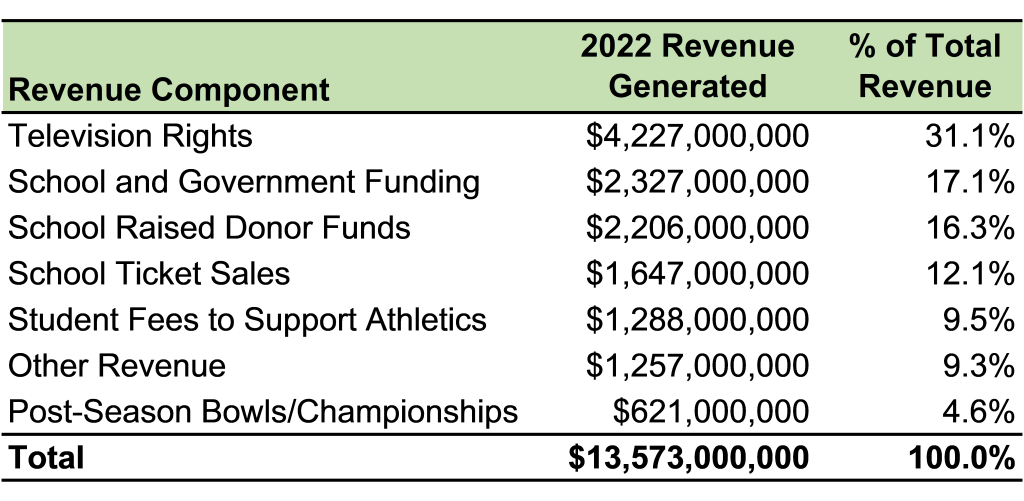
With the 2.6bn that the NCAA is forced to pay in settlements, that’s revenue that lots of Division I schools depend on. That money will either be on hold or decreased dramatically.
Now the NCAA is estimated to make around 7.5bn on TV deals and bowl games/championship games in 2026. While that may seem like a lot of money, the NCAA has a huge expense that they will have to pay off first, which is the settlement.
Time will only tell if top tier universities will break off and create their own division like Rishe mentioned, or if big teams will be forced to break apart top non-revenue programs like GCU had to do with their soccer team.
At the end of the day, it shouldn’t be about saving this amount of money, for the top athletes to get paid. It’s about the 60 athletes at Cal Poly who were getting ready for the swimming and diving season, just for them to be removed. Now thousands of other athletes will more then likely have similar stories.
It’s unfortunate that we are at a time where certain athlete’s favorite sports are getting dropped since they are being deemed ‘unprofitable’. College Athletes deserve to be paid, but it shouldn’t just be some. ALL College Athletes deserve to be paid some type of fund to play for them.
If you spot any errors or inaccuracies in this article, please don’t hesitate to reach out. Your feedback helps ensure accurate and high-quality reporting. Contact me at bearsportsnews@proton.me


 Bear Sports News
Leave a comment