
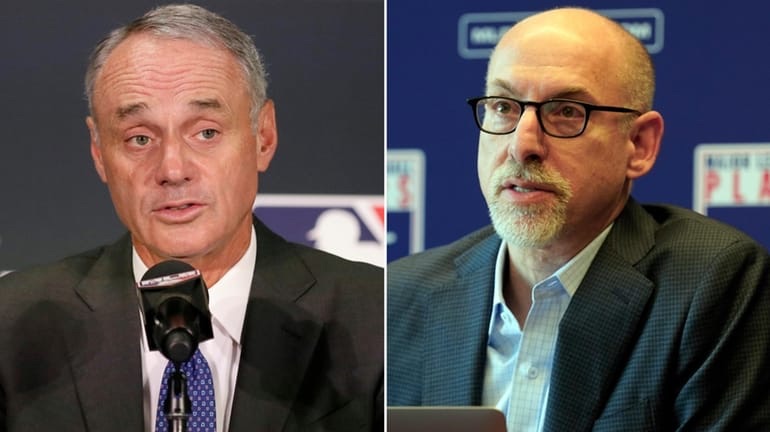
As we quietly approach December 1st, the expiration of MLB’s collective bargaining agreement. Both sides have been negotiating, and as things become more and more tense. It’s inevitable that we will suffer a lockout. MLB owners are already prepared to lock the players out to get some of their proposals accepted. We have a good idea of what the league is currently proposing but questions arise with some of their proposals.
101 players were polled in The Athletic’s anonymous player poll, where they asked players if they believed there would be a lockout. 80 players said yes, with 19 of them saying maybe and 2 of them saying no. The biggest issue that these two sides will be trying to negotiate is the implementation of a possible salary cap and floor.
Will players be content with taking a pay cut with the league’s proposed max contract rules? Is MLB really removing blackouts? Are players going to be content with a salary cap? All these questions and more will be answered as we breakdown the league’s latest two proposals and the union’s first proposal.
MLBPA’s First Proposal – Putting the Pressure on the Owners
The MLBPA and MLB are set to meet again sometime before the All Star Game but the MLBPA have been very clear. They absolutely do not wanna see a salary cap, and are willing to sit out as long as it takes to not have one. Back in May, the players union submitted their first labor proposal. They made it very public for all to see, and specifically the day before the owners were set to submit their first proposal. It included a soft salary floor with no cap, an increase to the minimum salary and moving the first luxury tax tier.
To no one’s surprise, the MLB said that the union’s proposal would only worsen the sport’s competitive balance.
“We appreciate the union making a set of proposals, and we look forward to continuing the bargaining process and working towards solving the competitive balance problem our fans are telling us needs to be addressed,” MLB spokesman Glen Caplin said. “We understand their proposals are designed to benefit players. Unfortunately, they do not address — and in fact exacerbate — the competitive balance problem our fans are telling us we must address. The MLBPA’s proposal would reduce the amount transferred to lower-revenue clubs, weaken the competitive balance tax and lead to even more payroll disparity than exists today. For example, under the union’s proposal, the Dodgers would pay less in luxury tax payments, giving them an additional $70 million to spend on payroll.”
The union’s first proposal had two of their proposals accepted by the MLB. The removal of the qualifying offer and allowing players to become free agents once they become 30 years old, with five years of service time.
- The players union also wanted more players to become Super-Two salary arbitration status. Currently 22% of players who reach two years of service time are eligible for a seven figure contract. The union is proposing that 44% be eligible for Super-Two status. Most players will reach arbitrations after three years of service time, with typically leads to their first seven figure salary. (Currently to qualify for Super Two designation, players must rank in the top 22%, in terms of service time, among those who have had between two and three years in the MLB and have accrued at least 86 days of service time during the season. Cutoff dates vary from year-to-year)
- Minimum salary to begin at $1.5m in 2027, $1.65m in 2028, $1.825m in 2029, $2m in 2030, and $2.2m in 2031.
- Moving the first tier of the luxury tax to $315m in 2028, $330m in 2029, $345m in 2030, and $360m in 2031.
- Currently, the pre-arbitration bonus pool is set at $180m, the players union wants it to rise 15m per year. This could possibly see the pre-arb pool at above $250m by 2031.
The union also included in its proposal the offering of a ‘competitive integrity tax’. If teams are under the proposed $150m set by the MLBPA, they would be penalized. Currently, 11 teams are under the $150m mark and it’s unknown what kind of penalties they’d face if this were to be accepted by the league.
“Our goal is to preserve and improve baseball’s market system, rewarding competition on and off the field,” interim executive director Bruce Meyer said in a statement issued shortly after a meeting concluded. “The players’ proposals provide increased revenue sharing, initially guaranteeing every small-market club a minimum of $240 million in revenue every season. This enhanced revenue sharing includes added protections to ensure clubs prioritize winning over profiteering. Ultimately, our proposals are designed to build upon the incredible momentum and popularity of our sport worldwide.”
MLB’s First Proposal; Dropping the Anchor
A day after, the MLB formally submitted their first economic proposal, and the anchor everyone was waiting for finally dropped. The MLB proposed a $245.3m cap, and a $171.2m salary floor. 20 teams either would have to increase payroll or decrease their payroll. The MLBPA calls it the ‘perfect excuse’ for owners who would rather not spend. Included in MLB’s proposal, was a 50-50 revenue split between owners and players. A 50-50 revenue split wouldn’t actually create new money if the minimum salary was ever increased. The union also argues that this 50-50 split would actually be a reduction from what they currently make.
In 2026, players are set to make 55% of the revenue, while owners will be walking away with 45%.
MLB teams approximately made $12.205bn in 2025, using the 55-45 split, players would be set to receive $6.876bn, while owners would receive $5.625bn
The MLB also proposed some new changes to how new contract signings would work, including the removal of deferred contracts and accepting the MLBPA’s proposal of removing the qualifying offer. All though, the union isn’t gonna be to quick to accept the MLB’s newest proposal that includes the removal of the QO.
- Max contract lengths and amounts set at five years, $202m. If a team is retaining it’s former players, then the team would be allowed to offer a six year, $265m deal.
- For free agents signing with a new team, they would not be allowed to make more than 15% of the cap; players who stay with team can’t make more than 16%.
- Salaries would be allowed to increase by up to 5% of the first year figure.
- Teams are allowed to offer players a 12 year, $500m deal, but there is some exclusions. The 12yr/500m max could only be offered to players with less that a year of service time. Money also decreases with each year of service. (For example, a player in his third year would be allowed to sign a max deal of nine-years, $382m, if the player were to sign in 2027.
- MLB proposed an increase to the minimum salary. All players would be entitled to $1m with minimum two years of service time. This new increase also includes players with 0 and 1 year players who accrue a full year of service. The unions proposal in May was set for 1.5m.
- MLB proposed the elimination of deferred contracts, meaning no contracts after the new CBA would be able to include deferrals.
- MLB proposed an offer that over time could lead to the end of territorial TV rights deals that create ‘blackouts’. Starting in 2029, MLB is planning to increase the number of nationally televised games, while reducing the number of games locally.
- MLB accepted both the MLBPA’s proposal to remove the qualifying offer, and their free agents proposal. The MLBPA argued that the qualifying offer ultimately hurts the players market as teams don’t wanna lose a draft pick by signing qualifying offer player. The free agent proposal allows players with five years of service time and 30 years of age to qualify for free agency.
- MLB also proposed creating a joint lobby with the MLB to ban prop bets and props relating to in game performance. This could likely mean a similar betting model to states who don’t allow betting on individual college player props.
Before we go any further though, i know which term jumped out at you, so let’s dive deeper into it. Unfortunately, it isn’t going to be as simple as we all think, and no matter what happens. We will still need a dozen of subscriptions to watch MLB. Unfortunately for fans, this may just be a dream that never happens.
The MLB is only offering to end local blackouts, if players accept a salary cap, which isn’t likely. The MLBPA believes that the owners are using this to make fans believe players have a say in TV deals, which the MLBPA stated that they don’t. “There are some aspects of media that really don’t involve us, like blackouts,” Meyer said. “That’s a function of the way the league has structured its media rights.”
It’s currently unknown whether owners would accept a removal of blackouts if players don’t agree to a salary cap. It’s also unknown whether a full removal of blackouts after 2029 would be possible due to teams signing their own local TV deals. It’s possible teams that have MLB.TV deals could be removed from blackouts in 2029, while teams like the Dodgers, Yankees and Mets could still be affected.
Owners are likely including the removal of blackouts due to the financial gain they’d receive from a salary cap. This opens up the possibilities of teams being very willing to share their local TV revenues equally.
“When you’re centralizing media rights, the focus on local territories goes way down,” Manfred said. “Who cares, right? Because it’s all going into one pot, and it creates flexibility in terms of dealing with the blackout issue.“I think that the Dodgers understand that there is a need to update the overall economic model in the industry,”
We will update you guys on the blackout talk as it progresses through negotiations.
MLBPA’s Response; “More San Diego’s”
Four days after the MLB’s terms of their first proposal emerged publicly, interim head of the MLBPA spoke publicly and addressed MLB’s proposal. Meyer mentioned how players would make less money overall, and players who turn pro, would be most affected, Meyer spoke in a video conference to a number of reporters and said “I thought they would try harder to make it look good, and they didn’t even do that.”
Meyer argued that the share of money that goes to the players or the owners — in this case, the 50-50 split MLB is proposing — “doesn’t tell you anything unless you know how ‘share’ is defined.”
“People should be aware their proposal deducts billions of dollars in expenses,” Meyer said. “It’s not even a real 50 percent.”
Glen Caplin, an MLB spokesperson, responded with a statement on June 1st, stating: “Our salary cap-and-floor proposal addresses our fans’ concerns by leveling the playing field while sharing baseball revenue with the players 50-50 like the other leagues. Under our proposal, major-league players will receive more compensation in year one of the system than in 2026. We are ready to listen if the MLBPA wants to counter our proposal at the bargaining table.”
At the end of the day, the union doesn’t want to see high-spending teams be punished. They wanna see smaller-market teams spend more.
”Every team has the ability to do what the Brewers are doing, what the Padres have done, or what Tampa has always done,” Meyer said. “One of the things that I find kind of ironic in a perverse way: if Team X decides we’re not going to spend money on players, well, that increases the disparity in payroll, right? They can themselves increase the disparity by choosing not to spend. We want to encourage more San Diego’s.”
Despite teams making a combined $12.205bn in 2025, the total MLB payroll was $6.339bn, for an average payroll of $211.3m. Over 50% of the league falls below the $211.3m average.
Payroll and revenue was pulled via Forbes.
MLB’s Proposed Draft Changes; Removal of High School Commits
A few weeks ago, MLB also proposed massive changes to the domestic draft, as well as the international draft. This could be another point of topic that drags out these negotiations. The main headline that everyone has been talking about, is the removal of high school players entering the domestic draft. There are multiple other bullet points that could possibly change how minor leaguers make their way to the show.
- MLB proposed that both drafts change to 12 rounds, and each draft would come with a 200m bonus. This would include hard slots where each pick makes a specified amount of money depending on their position of selection. The current domestic draft is 20 rounds and players are allowed to negotiate their own contracts. In 2025, domestic amateurs made an upwards of $400m, with international players making just below $200m. Teams are expecting to pay another 600m+ this year as the final year of the CBA winds down. MLB is looking to reduce the teams payroll by at least 200m, but the MLBPA says that’s just the tip of the iceberg. The MLBPA says the league is actually reducing it by 400m, since the league is proposing to not hold an international draft in 2027. This means only six international drafts would take place during the seven year CBA. Only 2,160 international players would enter the MLB, down from the 2,520, if MLB held an international draft in 2027.
- MLB is proposing, that starting in 2028, domestic draftees must be 20 years old by Sept 1st, and must be two years removed from high school graduation.
- MLB proposed raising the age where international players can enter the draft to 18 years old, previously was 17 years old.
- MLB proposed allowing teams to trade draft picks in both drafts, but domestic draft picks can only be traded for the year after the draft. For example, after the 2027 draft, teams would be allowed to trade their 2028 picks.
- The MLB mentioned that teams wouldn’t be allowed to deal away first round picks in consecutive years. As well as not allowing teams to acquire more than three additional selections in the first three rounds of a given draft. For example, a team can’t acquire two second-round picks, if they already have one.
- MLB says most international picks could be traded but there will be “certain limitations”.
- MLB is proposing changes to the number of teams subject to draft lottery from four to six.
- MLB is proposing mandatory medical evaluations before the draft. The league has previously tried to get this in a CBA but both sides couldn’t find a middle ground.
The MLB has also proposed an overhaul to the international amateur system. The league says that it “would address long-standing challenges and benefit future players”. MLB said in a statement. “The enhanced transparency of the international draft that we are proposing is a common-sense step forward that best addresses the root causes of corruption in the current system.
“Our vision for the new international system reduces the pressure on young athletes by giving them the chance to grow and develop, keeps kids in school longer while they pursue a career in baseball, and creates more playing opportunities for the older players who are left behind in today’s system.”
In the past, MLB team officials have reached verbal agreements with players as young as 13 years old, with most of those players being from the Dominican Republic. Teams are technically allowed to sign players as young as 16, as long as they reach 17 by Sept 1 of the given year. Young players have also been forced to pay their trainers extreme fees once they put pen to paper.
MLB’s proposal of an international draft would likely put an end to those ‘early deals’ that players enter in with teams, but it’s unclear if this will help players. The question rises now, will a draft help players keep their costs low as they enter into the league with agents and top-tier personal trainers?
MLB hopes that this partnership with the Dominican government will help players with that. The MLB released the proposed protections that the Dominican Republic will help enforce.
- A code of conduct for independent trainers with appropriate penalties
- The prohibition of any individual or firm from purchasing an interest in the player’s future signing bonus and/or salary, as well as loaning a player and/or family with the player’s future signing bonus or compensation as collateral.
- Implementation of lifetime bans from the baseball industry and criminal penalties, for any performance who provides performance enhancing substances to a player.
- A requirement that players who reside in an independent trainer academy prior to age 18, must remain enrolled in an education program.
MLB hopes by limiting the number of international players that teams can sign, that international players can become more successful. Currently only 6% of international players reach the MLB and 44% of them are released within the first three years of being signed.
Final Thoughts – Should We Be Worried?
We were asked by a reader, how long this lockout might last. Honestly, i can’t give you a straight answer. In 1994, we saw the cancellation of the entire World Series. While, i don’t think it will get that far, will owners and players allow it to go that far?
I don’t see the players budging at all for an implementation of a salary cap. I completely understand where they are coming from as well. If your company said they are gonna force departments to cut payroll, you’d probably wanna have a word with who made that decision. That’s how players feel, once their contracts are up, why would you get undervalued?
Tarik Skubal, Shota Imanga and Randy Arozarena are just a few of the names set to hit free agency in 2027? Are these three names really worth five years, 202 million? While they probably wont be signing Ohtani level deals, they are 100% worth more than 202 million. How long the lockout will come down to one thing and one thing only. How long are owners willing to not make any money from their biggest investment? Will they be able to take the heat from their day-to-day staff if this goes into the regular season and are forced to create cost-saving measures? That’s realistically the last straw that will need to bend in order for the CBA to be signed by both sides.
While i agree, the spending in the league has gotten excessive. Teams are bringing in some of the highest revenue they’ve seen since 2017. It’s a matter of why aren’t these owners reinvesting it back into their teams? Teams like the Marlins and Rockies rank at the bottom of destinations to be as a player.
Players spoke to The Athletic anonymously said about the Rockies, “Behind on everything analytically. I’ve seen the way they do their business as a whole, and they make a lot of decisions where I’m like, ‘What are you doing?’.
Teams like the Yankees, Dodgers and Cubs ranked at the top of The Athletic’s poll. If you continue to invest in your team, and make it a place to be, the players will try everything they can to bring a trophy in return.
When asked anonymously about the Dodgers, one player said “Everybody’s been talking about how they really create good relationships with players on and off the field.”
On the Cubs, the player mentioned how they treat everyone the right way. “Everybody I’ve talked to raves about them. … They say they’re very professional, they treat the players and the families the right way. And obviously, Wrigley is Wrigley.”
Owners shouldn’t be punished for spending, we’ve seen that having the most money doesn’t always amount to wins. If that was the case, the Mets and Dodgers would be undefeated right now, but they aren’t. Hell, the Mets aren’t even leading the Wild Card race. While the Dodgers have won the previous two World Series, this season, despite having the highest payroll on paper, have shown weaknesses at times.
Teams like the Brewers, Rays and White Sox have made surprising pushes towards playoff pushes and could make some noise. That’s what it’s about, making some noise, putting your name on the map for players hitting free agency to know, we are one player away from a ring.
A salary cap isn’t going to be the solution to all our problems. Teams would still have their long and high contracts on the team, unless the MLB says to cut them. Which would probably be worse to do to players than a cap. It’s time to force owners to spend and make their clubhouses places that players wanna play. A cap doesn’t even the playing field, but a floor does.


Leave a Reply